When visibility drops to zero, your driving strategy needs a complete overhaul. Here’s how to navigate the disorienting, dangerous world of dense fog and arrive safely.
There’s a unique kind of anxiety that sets in when you drive into a wall of dense fog. One minute, you’re cruising along, music playing, mind on your destination. The next, the world outside your windshield has vanished, replaced by a swirling, opaque gray that swallows the road just a few feet ahead. It’s disorienting, to say the least. I’ll never forget a late-night drive across the Central Valley where the tule fog became so thick, so suddenly, that it felt like I had been teleported into a cloud. My knuckles were white on the steering wheel, and every instinct screamed at me to just stop, which, as it turns out, isn't always the safest move.
This isn't just about getting a little spooked; driving in fog is statistically one of the most dangerous weather conditions a driver can face. The Federal Highway Administration reports that over 38,700 vehicle crashes occur annually in fog, resulting in over 600 deaths and more than 16,300 injuries. The danger lies not just in the lack of visibility, but in how fog deceives our perception of speed and distance. It creates a false sense of slow movement, tempting drivers to go faster than they should. Understanding how to counteract these illusions is not just a good idea—it’s a critical survival skill.
Your First Defense: Slow Down and See Correctly
It sounds like the most obvious advice in the world, but its importance cannot be overstated: you must reduce your speed significantly. Your speed should be slow enough that you can come to a complete stop within the distance you can see ahead. If you can only see 100 feet in front of you, you need to be driving slow enough to react and brake for a stationary object within that 100-foot window. This is not the time to keep up with traffic or worry about who is behind you. Your only job is to manage the space directly in front of your vehicle.
This also means turning off cruise control. Fog is unpredictable, with visibility that can change in an instant. You need to be in complete command of your acceleration and braking. And while you’re adjusting your speed, make sure your view is as clear as possible from the inside. Use your defroster and windshield wipers to keep the glass free of moisture. It’s a small thing that makes a huge difference in maximizing what little visibility you have.
The Art of Being Seen (Without Blinding Yourself)
When visibility drops, the temptation is to use the most powerful lights you have. This is a critical mistake. Never, ever use your high-beam headlights in fog. The light from the high beams will reflect off the tiny water droplets in the air, creating a wall of glare that can be completely blinding. It’s the equivalent of shining a flashlight directly into your own eyes.
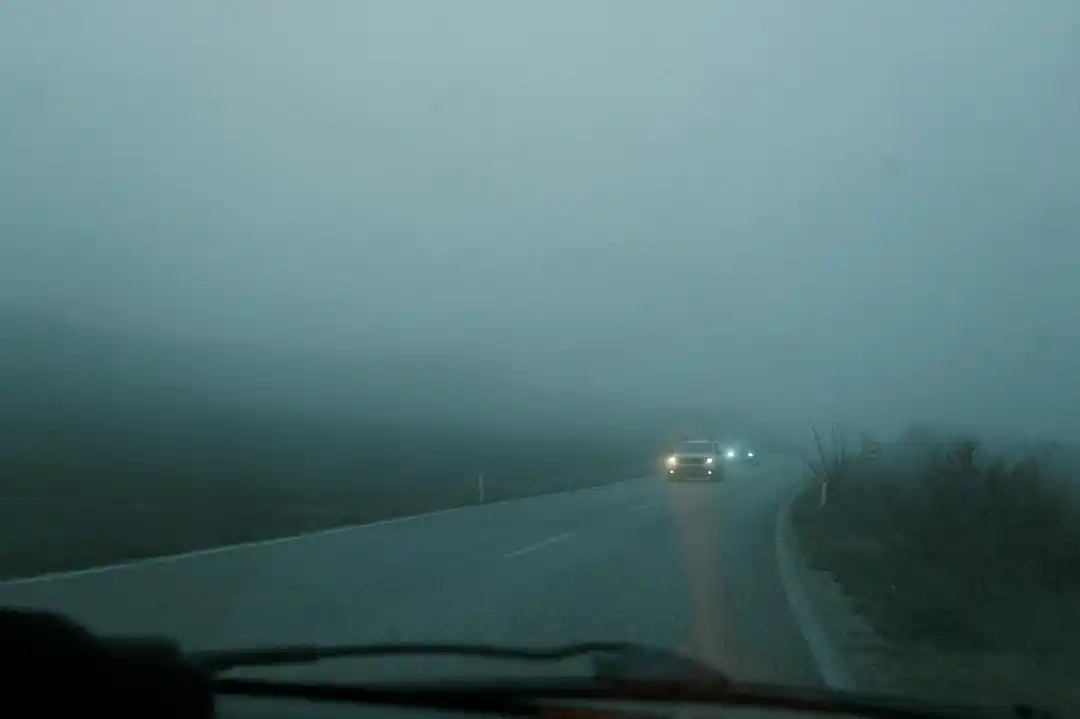
Instead, always use your low-beam headlights. They are aimed downward, illuminating the road surface beneath the fog and reducing reflection. This also ensures your taillights are on, making you visible to the drivers behind you. If your vehicle is equipped with fog lights, now is the time to use them. They are mounted low on the vehicle and are designed to throw a wide, low beam that cuts under the fog. Just remember to turn them off when the fog clears, as they can be distracting to other drivers in normal conditions. And a quick note on hazard lights: do not use them while driving. It is illegal in many states and can confuse other drivers into thinking you are stopped or stalled.
When the Only Safe Move Is No Move at all
Sometimes, the fog is simply too dense to navigate safely. If you find yourself in a situation where you can barely see the hood of your own car, it's time to pull over. But how you pull over is just as important as the decision itself. Signal your intention early and slow down gradually. Pull as far off the road as you possibly can. A soft shoulder is better than being partially in a traffic lane.
Once you are completely stopped and safely off the roadway, take two crucial steps. First, turn off your driving lights. Leaving your headlights on can confuse other drivers into thinking your car is in a lane of traffic and that they should follow you—leading them right off the road. Second, now is the time to turn on your emergency flashers or hazard lights. This alerts other drivers to your stationary position. After that, all you can do is take your foot off the brake and wait patiently for the fog to lift.
Driving in fog is a profound exercise in patience and humility. It forces us to slow down, to heighten our senses, and to respect the power of the elements. It’s a situation where the destination is secondary to the journey—a journey that must be undertaken with the utmost care. By embracing a slower pace and a more defensive mindset, you can ensure that you and everyone else on the road make it through the veil safely.

Riding the Waves: What to Expect From Ferry Travel in Any Weather
Beyond the Boardwalk: Finding Serenity in America's Most Charming Coastal Towns

Related Posts
 TRANSPORT
Beyond the Highway: Finding Canada's Soul on a Western Rail Adventure
Forget road trips. I'm talking about rediscovering the romance of travel on Via Rail's most scenic routes through the heart of the Canadian West. It’s an experience that changes you.
 TRAVEL TIPS
The Unwritten Rules of the North: What to Know Before Camping in Canada
Heading to the Great White North for a camping trip? It's an amazing idea. But from campfire etiquette to wildlife wisdom, here’s what you need to know before you go.

Popular Posts

Beyond Stark White: The Best Interior Paint Colors to Light Up Your New Space

How to Actually Master a New Language on Your Own (No Magic Gene Required)

The Simple Pre-Workout Fueling Strategy That Saved My Long Runs