Tired of thinking you need a gym to get a great workout? Discover how to build a powerful, effective High-Intensity Interval Training (HIIT) routine right in your living room. No equipment, no excuses.
Let’s be honest for a second. How many times have you told yourself, “I’ll start working out on Monday,” only for Monday to come and go with the same old routine? Life gets busy. Gyms can be intimidating, not to mention expensive. And sometimes, the sheer thought of figuring out what to do is enough to make you want to curl up on the couch. I’ve been there more times than I can count. For years, I thought a "real" workout meant at least an hour sweating on some complicated machine.
Then I discovered High-Intensity Interval Training (HIIT), and it completely changed the game for me. The idea that you could get a more effective workout in less time—and without leaving the house—sounded too good to be true. But after diving into the research and, more importantly, trying it myself, I realized it’s one of the most accessible and powerful ways to get fit. It’s not about spending hours; it’s about making the minutes count.
This guide is for anyone who feels stuck in that "I want to, but..." phase. We're going to break down exactly how to create a beginner-friendly HIIT workout you can do at home, with zero equipment. It’s time to prove to yourself that you have everything you need to start your fitness journey right now.
The Magic Behind HIIT: Why It Works So Well
So, what exactly is this magic acronym? HIIT stands for High-Intensity Interval Training. The concept is brilliantly simple: you alternate between short bursts of all-out effort and brief periods of rest or low-intensity movement. Think sprinting for 30 seconds, then walking for 60 seconds, and repeating. This structure pushes your body into an anaerobic state, which is a fancy way of saying it’s working so hard it can't get oxygen to the muscles fast enough.
Why is this so effective? This process kicks your metabolism into high gear. The real magic happens after the workout. Your body has to work hard to recover and return to its normal state, a process known as Excess Post-exercise Oxygen Consumption (EPOC), or the "afterburn effect." This means you continue to burn calories at an elevated rate for hours after you’ve finished sweating. Research from the American College of Sports Medicine has highlighted that HIIT can deliver the same, if not greater, health benefits as longer, moderate-intensity workouts in a fraction of the time.
For home workouts, this is a dream come true. You don’t need a treadmill or an elliptical to get your heart rate up. Simple bodyweight exercises, when done with high intensity, are more than enough. This makes it a sustainable, practical, and incredibly efficient way to build cardiovascular health and burn fat without ever stepping foot in a gym.
Building Your First At-Home HIIT Routine
Okay, theory is great, but let's get practical. The key to a good beginner routine is choosing exercises that are simple to perform but effective at raising your heart rate. You also want to start with a forgiving work-to-rest ratio. A 1:2 ratio is perfect for beginners. This means if you work for 30 seconds, you rest for 60 seconds. This gives your body ample time to recover so you can give maximum effort on the next interval.
Here is a sample circuit of six fundamental bodyweight exercises. They require no equipment and target different muscle groups for a full-body workout.
- Jumping Jacks: The quintessential warm-up exercise is also a fantastic HIIT movement. It’s a full-body exercise that’s easy on the joints when done correctly.
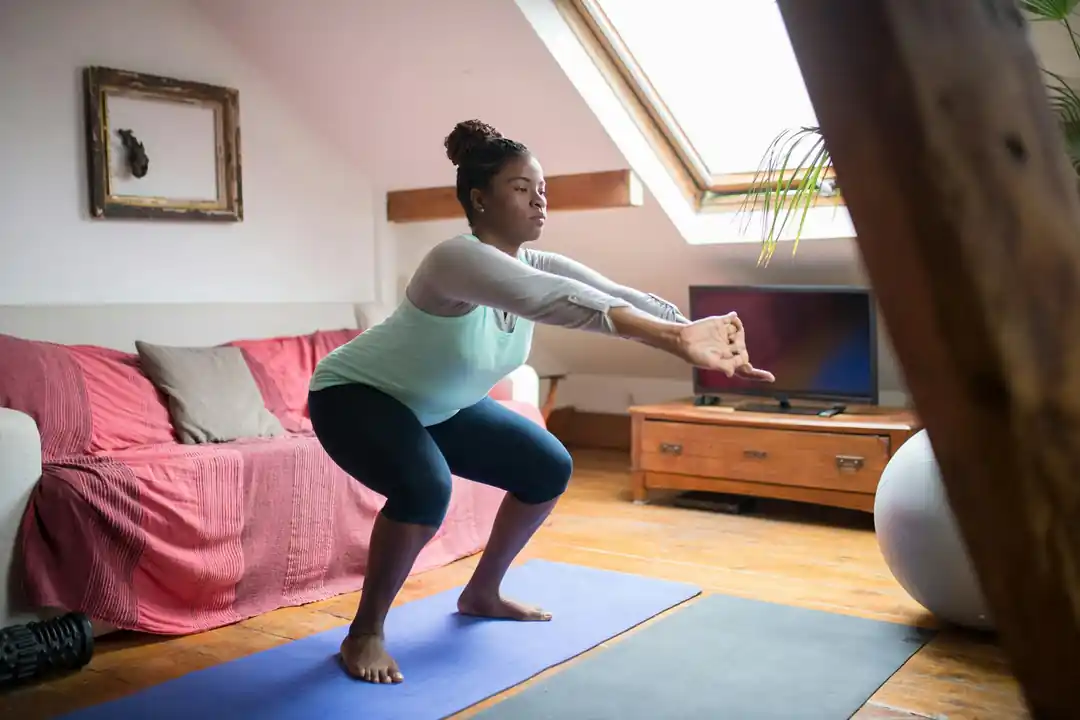
- Bodyweight Squats: A powerhouse for building leg strength. Focus on keeping your chest up and back straight, sinking your hips as if you’re sitting in a chair.
- High Knees: This is like sprinting in place. Drive your knees up toward your chest as quickly as you can, engaging your core to stay stable.
- Push-ups (Modified if needed): A classic for upper body and core strength. If a full push-up is too much, start on your knees. The goal is proper form, not depth.
- Mountain Climbers: From a plank position, alternate driving your knees toward your chest. This is a killer for your core and cardiovascular system.
- Lunges: Alternate legs with each rep. Lunges are amazing for your glutes, quads, and hamstrings, and they also challenge your balance.
The Workout Plan:
- Warm-up (5 minutes): Start with light cardio like marching in place, arm circles, and leg swings.
- HIIT Circuit (12 minutes):
- Perform each exercise for 30 seconds with maximum effort.
- Rest for 60 seconds between each exercise.
- Once you complete all six exercises, you’ve done one round.
- Cool-down (5 minutes): Don't just collapse! Walk around slowly and do some gentle stretching to help your muscles recover.

Form Over Speed: The Golden Rule of Injury Prevention
I cannot stress this enough: your goal as a beginner is not to be the fastest. Your goal is to be the safest. Poor form is the quickest way to get injured and derailed from your new routine. Before you even attempt your first HIIT session, take a few minutes to watch videos on the proper form for each exercise. Record yourself if you can, and compare it to the experts.
When you’re in the middle of a high-intensity interval, your mind will tell you to just go, go, go. But you have to fight that urge and focus on quality over quantity. For squats, ensure your knees are tracking over your feet and not caving inward. For push-ups, keep your body in a straight line from your head to your heels (or knees). A few perfect reps are infinitely more valuable than a dozen sloppy ones.
Listen to your body. There’s a difference between the discomfort of a challenge and the sharp signal of pain. If something hurts, stop. It’s okay to modify. Can’t do a full jumping jack? Step out to the side instead. Feeling overwhelmed? Add an extra 30 seconds of rest. This is your workout, and adapting it to your current fitness level is a sign of wisdom, not weakness.
Making It a Habit: From First Try to Fitness Lifestyle
That first workout might leave you breathless, sore, and wondering what you got yourself into. That’s normal! The key is to come back for the next one. Consistency is what turns effort into results. Start with just two HIIT sessions a week. That’s it. Give your body a day or two of rest in between to recover and rebuild.
As you get stronger, you can start to progress. Maybe you shorten your rest time to 45 seconds, moving toward a 1:1.5 work-to-rest ratio. Or perhaps you add a second round to your circuit. You could even swap in more challenging exercises, like burpees or jump squats (but please, only when you feel truly ready!). The possibilities are endless, and this scalability is what makes HIIT a sustainable long-term strategy.
Remember that every small step is a victory. You’re not just building muscle; you’re building discipline, resilience, and a profound sense of self-efficacy. You’re proving that you have the power to change your health and your life with nothing more than a little space on your floor and the will to move. So go ahead, give it a try. You might just surprise yourself.

Beyond the Bleachers: Winning Marketing Strategies for Your Local Sports Team
Fuel Your Inner Champion: A 7-Day Athlete's Meal Plan for Peak Performance

Related Posts
 NUTRITION
The Simple Pre-Workout Fueling Strategy That Saved My Long Runs
Discover how timing your carbohydrates and embracing simple foods can eliminate mid-workout fatigue and unlock your true endurance potential.
 FITNESS
No Gym, No Problem: The Ultimate Guide to Bodyweight Fitness at Home
Forget expensive memberships. Discover how to build serious strength and transform your body using the most powerful tool you already own: yourself.

Popular Posts

Rethinking Non-Profit Promotion: Creative Strategies That Actually Drive Event Impact

Beyond Stark White: The Best Interior Paint Colors to Light Up Your New Space

How to Actually Master a New Language on Your Own (No Magic Gene Required)