Feeling awkward with a basketball? You're not alone. Let's walk through the foundational dribbling drills that will build your confidence and control on the court.
Honestly, there are few things more frustrating than wanting to play basketball but feeling like the ball has a personal vendetta against you. I’ve been there. You try to move, and the ball bounces off your foot. You look up for a split second, and it’s suddenly rolling away. It’s a feeling of clumsiness that can make you want to just put the ball down and walk away. But what if I told you that the fluid, controlled dribbling you see from players on the court isn't some innate talent? It’s a skill, built piece by piece, bounce by bounce.
That journey from awkward to confident is paved with practice. It’s not about spending eight hours a day in the gym, either. It’s about smart, consistent work on the fundamentals. I recently read a coaching guide that emphasized how just 15 minutes of focused daily practice can completely transform a beginner's handle in a matter of weeks. That’s the secret: it’s accessible to anyone. We’re going to break down the essential drills that will build your foundation, quiet that feeling of frustration, and help you finally feel in control of the ball.
It Starts with the Fingertips
Before we even get into drills, we have to talk about the single most important (and often overlooked) aspect of dribbling: how you touch the ball. Most beginners make the mistake of slapping at the ball with their palms. This is dribbling suicide. You have almost no control when you use your palm; you’re essentially just hitting the ball and hoping it comes back to the right spot. The real control comes from your fingertips.
Think of your fingers as shock absorbers and a guidance system all in one. You want to push the ball down with your fingertips, extending your wrist and elbow. As it comes back up, you receive it with those same soft fingertips, guiding it into the next dribble. Your stance is just as important. Get low. Bend your knees, keep your back relatively straight, and get into an athletic position. A low center of gravity gives you stability and makes it much harder for a defender to poke the ball away. And the golden rule you’ll hear a million times? Get your head up. It feels impossible at first, but you can’t see the court, your teammates, or the basket if you’re staring at the ball.
Stationary Drills: Your Control Center
This is where you build the muscle memory that forms the bedrock of your handle. You don’t need a full court, just a small patch of concrete and a ball. These drills are designed to be repetitive, forging a connection between your hand and the ball until the movements become second nature. Don't rush them; focus on the quality of each and every dribble.
First up is the Pound Dribble. It’s simple but powerful. In your athletic stance, dribble the ball as hard as you can with one hand, keeping the bounce low and controlled (somewhere between your knee and your waist). The force you use makes the ball return faster, forcing your hand to keep up and building strength. Do 50 with your right hand, then 50 with your left. Yes, your non-dominant hand will feel incredibly awkward. That’s the point. Embrace the awkwardness; it’s a sign you’re improving.
Next, let's get into Low Dribbles. In the same stance, try to dribble the ball as low as you can, aiming for ankle height. These are tiny, rapid-fire dribbles. This drill is fantastic for developing the fine motor control in your fingertips. Then, progress to Crossovers. Start with a comfortable dribble in your right hand, then cross the ball over to your left in a tight "V" shape in front of you. Keep the dribble low and quick. The goal is to make the transition seamless, without a high, loopy bounce that’s easy to steal. Alternate back and forth, focusing on that crisp movement.
On the Move: Integrating Movement with Control
Once you feel a degree of comfort with stationary drills, it’s time to add the most important element: movement. Dribbling while standing still is one thing; maintaining that control while walking, jogging, and running is what basketball is all about. This is where you’ll start to feel the real-world application of the foundation you’ve been building.
Start simple. Just Walk the Court while dribbling. Go from one baseline to the other, first with your right hand, then back with your left. Your primary focus should be on keeping your head up. Pick a spot on the far wall and fix your eyes on it. Trust your hand to control the ball without you looking. It will feel scary, and you will lose the ball. That’s okay. Every time you lose it, it’s a lesson. Once you’re comfortable walking, pick up the pace to a jog.
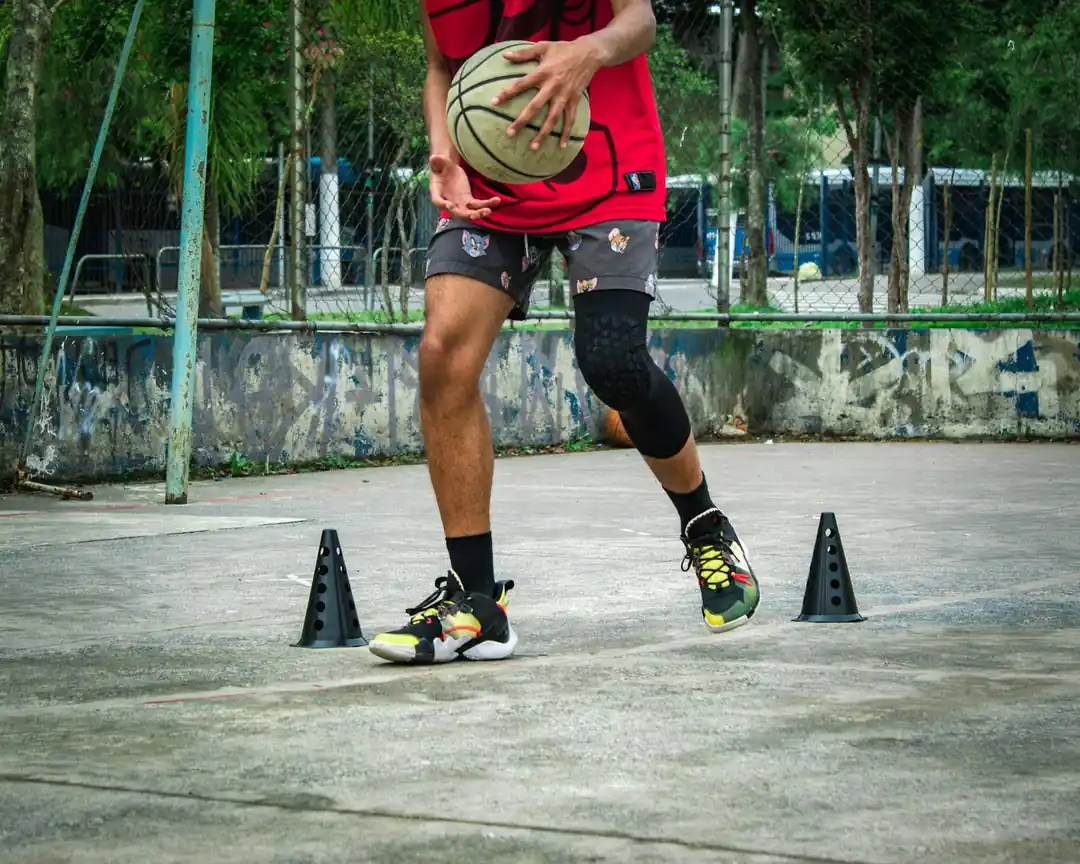
Now, let’s make it more game-like with the Zig-Zag Drill. Set up some cones (or shoes, water bottles, whatever you have) in a staggered line. Dribble through the cones, performing a crossover or another move at each one to change direction. This drill is crucial because it simulates navigating through defenders. As you approach a cone, use your body to shield the ball and execute a quick, low move to change your path. This teaches you to not only handle the ball while moving but also to be strategic about protecting it.
The Journey is the Reward
Look, nobody becomes a great ball-handler overnight. It’s a process filled with moments of frustration and small, incredible breakthroughs. The key is to fall in love with that process. Find joy in the simple rhythm of the ball hitting the pavement. Challenge yourself. Can you do 100 weak-hand dribbles without losing it? Can you get through the zig-zag drill faster than you did yesterday?
Don’t compare your chapter one to someone else’s chapter twenty. Everyone starts somewhere. The fluid control you’re aiming for is waiting for you, but it demands consistency. That 15 minutes a day is your investment in your future self, the one who can confidently move with the ball, head up, ready to make a play. Keep at it, stay patient, and I promise you’ll be amazed at how far you can go.

The Unsung Hero of Your Finances: Why an Attorney Is a Key Player in Your Risk Management Strategy
The Ultimate Guide to Homemade Chicken Nuggets (You'll Never Go Back)
Related Posts
 NUTRITION
The Simple Pre-Workout Fueling Strategy That Saved My Long Runs
Discover how timing your carbohydrates and embracing simple foods can eliminate mid-workout fatigue and unlock your true endurance potential.
 FITNESS
No Gym, No Problem: The Ultimate Guide to Bodyweight Fitness at Home
Forget expensive memberships. Discover how to build serious strength and transform your body using the most powerful tool you already own: yourself.

Popular Posts

Rethinking Non-Profit Promotion: Creative Strategies That Actually Drive Event Impact

Beyond Stark White: The Best Interior Paint Colors to Light Up Your New Space

How to Actually Master a New Language on Your Own (No Magic Gene Required)