Ever dream of crafting your own music? It's closer than you think. Here’s a real-talk guide to starting your indie music journey from a home studio.
There’s a certain kind of magic that happens late at night, isn’t there? The world is quiet, and suddenly, a melody pops into your head. A lyric. A beat. For years, I thought that’s where it had to end for people like us—the dreamers without a record deal or access to a fancy studio. The idea of producing my own music felt like trying to build a spaceship in my garage. It seemed impossibly complex, wildly expensive, and reserved for a select few.
But I was wrong. Honestly, the landscape has shifted so dramatically that the gap between a simple idea and a fully produced track has never been smaller. Your bedroom, your garage, or even a corner of your living room can become a legitimate creative powerhouse. The rise of indie artists on platforms like Spotify and Apple Music isn't an accident; it's a testament to the power of the home studio.
This isn't about becoming a superstar overnight. It's about something more fundamental: giving your ideas a voice. It’s about the profound satisfaction of taking a feeling and turning it into a sound that someone else can connect with. So, let's talk about how you can actually start doing that, without the gatekeeping and without needing to take out a second mortgage.
The Heart of the Operation: Your First Studio Setup
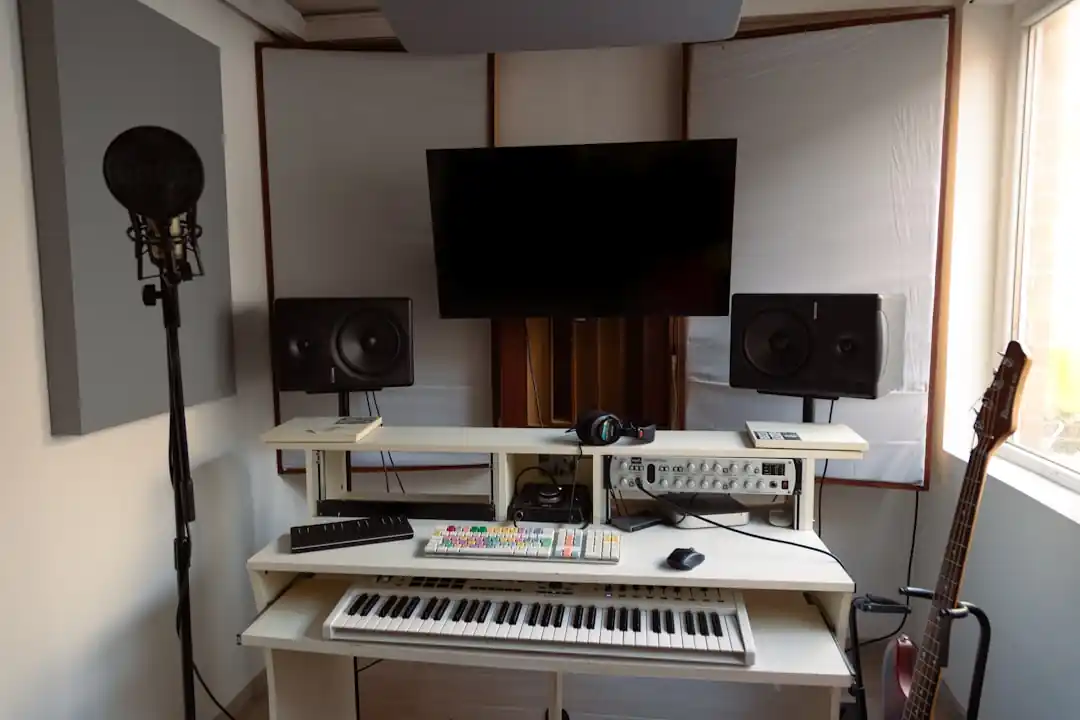
Before you get lost in a sea of online shopping carts, let’s get one thing straight: you do not need everything at once. I wasted so much time and energy convinced that the next piece of gear would be the one to unlock my potential. The truth is, a solid, minimal setup is more than enough to create professional-quality music. It’s about the craftsman, not just the tools.
First, your computer is the brain. Mac or PC, it doesn’t really matter, as long as it’s powerful enough to handle modern software. I’d suggest at least 16GB of RAM and a solid-state drive (SSD) if you can swing it—it makes everything run so much smoother. This machine will host your Digital Audio Workstation (DAW), which is the software where you'll record, arrange, mix, and produce. There are incredible, industry-standard options like Ableton Live, Logic Pro X (for Mac users), and FL Studio. But don't overlook the free or more affordable powerhouses. GarageBand comes free with every Mac and is an astonishingly capable starting point. On the PC side, Cakewalk by BandLab is a full-featured professional DAW that is completely free. Pick one, watch a few tutorials, and commit to learning its workflow.
Next, you need to get sound in and out of your computer. This is where an audio interface and a microphone come in. The interface is a small box that converts the analog signal from your microphone or guitar into digital information your computer understands. The Focusrite Scarlett 2i2 is practically a rite of passage for home producers for a reason—it’s affordable, reliable, and sounds great. For a microphone, a versatile large-diaphragm condenser mic like the Audio-Technica AT2020 or Rode NT1 will capture vocals and acoustic instruments with beautiful clarity. Don't forget a pop filter and a stand!
Finally, you need to hear what you’re doing accurately. Start with a good pair of closed-back studio headphones, like the Audio-Technica ATH-M50x or Sony MDR-7506. They prevent sound from leaking out while you’re recording and give you a detailed picture of your audio. While studio monitors (speakers) are an amazing tool, they are heavily influenced by the room you're in. A pair of quality headphones in an untreated room will give you a more honest sound than expensive monitors will.
From Noise to Music: The Art of Recording and Mixing
Once your gear is set up, the real fun begins. This is where you start translating your ideas into actual sound waves. The first hurdle is getting a clean recording. You don't need a perfectly soundproofed vocal booth. Hanging up a few heavy blankets, recording in a closet full of clothes, or strategically placing bookshelves can do wonders to absorb sound reflections and deaden a room. The goal is to capture your performance with as little "room sound" as possible, giving you a clean canvas to work with.
With your tracks recorded in your DAW, you enter the mixing stage. If recording is capturing the ingredients, mixing is the cooking. This is the process of balancing the levels of each track, placing them in the stereo field with panning (left to right), and using tools like EQ and compression to make sure everything has its own space. EQ (equalization) is like a sonic sculptor, allowing you to cut or boost specific frequencies so instruments don't fight each other. For example, you might cut some low frequencies from the guitars to make space for the bass and kick drum.
Compression is another key tool, but it's often misunderstood. In simple terms, it reduces the dynamic range of a track—making the quiet parts louder and the loud parts quieter. This can add punch and presence, helping a vocal sit right on top of a mix instead of getting lost. A word of caution: it's incredibly easy to overdo it. The "less is more" philosophy is your best friend when you're starting out. The goal of a good mix isn't for people to notice the cool effects; it's for them to feel the song.
Finding Your Voice in a Digital World
The technical skills are crucial, but they are nothing without the creative spark. Producing indie music is about finding your unique sound, not just copying what's popular. This is where the "in-the-box" nature of a home studio truly shines. Your DAW is a playground filled with virtual instruments (VSTs), samplers, and effects that would have cost a fortune in hardware just a couple of decades ago.
Spend time just exploring these sounds. Pull up a weird synth patch and see what happens when you run it through a distorted delay. Chop up a vocal sample and turn it into a rhythmic instrument. Some of the most iconic sounds in music history were born from happy accidents and a willingness to experiment. Don't be afraid to sound strange or different. That's what "indie" is all about—independence from the norm.
Collaboration is another powerful tool. In today's world, you don't need to be in the same room to make music together. Send a beat to a friend who sings. Get a guitarist from another state to lay down a solo over your track. This cross-pollination of ideas can push you in directions you never would have found on your own and bring a new level of energy and life to your projects.
Most importantly, finish your songs. It’s so easy to get stuck in an endless loop of tweaking, adding one more layer, or starting a new project because the current one feels imperfect. A finished, imperfect song is infinitely better than a "perfect" 8-bar loop that never sees the light of day. Each track you complete teaches you something that you'll carry to the next one.
This journey of creating music is one of the most rewarding things you can do. It's a conversation with yourself and, eventually, with the world. It will be frustrating at times, but the moments of breakthrough—when the mix finally clicks, when the harmony sends a shiver down your spine—are pure, unfiltered joy. So, clear a little space, plug in, and start making some noise. The world is ready to listen.
Beyond the Alarm: A Homeowner's Guide to Real Fire Safety
Method Acting for Beginners: How to Start Without Losing Your Mind
Related Posts
 HOBBIES
The Beginner's Guide to Reading the Night Sky: How to Spot Your First Constellations
A friendly, grounded guide to navigating the night sky, understanding stellar movements, and spotting iconic constellations without expensive gear.
 PETS
PETSSniffle-Free Snuggles: America's Most-Loved Hypoallergenic Dogs
Dreaming of a furry friend but dreading the sneezes? You're not alone. Let's dive into the wonderful world of popular hypoallergenic dog breeds in the US.
Popular Posts

Rethinking Non-Profit Promotion: Creative Strategies That Actually Drive Event Impact

Beyond Stark White: The Best Interior Paint Colors to Light Up Your New Space

How to Actually Master a New Language on Your Own (No Magic Gene Required)
