Ever wonder how we turn faint signals from distant galaxies into breathtaking images and groundbreaking science? It's all thanks to an incredible array of software that translates the universe's data.
Have you ever stared at a Hubble image, completely mesmerized by the swirling colors of a distant nebula, and wondered how it all comes together? It’s not like there’s a giant camera in space with a simple point-and-shoot button. The reality is far more complex and, honestly, way more interesting. The universe is the ultimate source of big data, constantly streaming petabytes of information back to Earth from telescopes, satellites, and probes scattered across the solar system. Making sense of that cosmic firehose of data is one of the greatest challenges in modern science.
I used to think of astronomers as people who just spent their nights glued to a telescope eyepiece. But the modern astronomer is as much a data scientist as they are a stargazer. They wield powerful software to clean, process, visualize, and interpret data that is often invisible to the naked eye. This software is the unsung hero of space exploration. It’s the digital backbone that transforms raw, often messy, signals into the breathtaking discoveries that rewrite our textbooks and expand our understanding of our place in the cosmos.
From the core programming languages that form the foundation of analysis to highly specialized platforms that monitor our own planet, the software ecosystem for space data is vast and constantly evolving. It’s a world where open-source collaboration fuels discovery and where artificial intelligence is beginning to chart its own course through the stars. Let's pull back the curtain on the digital tools that make it all possible.
The Workhorses: Core Programming and Foundational Tools
At the very heart of astronomical research, you'll find a handful of powerful programming languages and libraries that do the heavy lifting. These are the fundamental building blocks that scientists use to create custom scripts and sophisticated analysis pipelines. Without them, the journey from raw telescope data to scientific insight would be nearly impossible. They provide the flexibility to tackle unique problems and the power to process enormous datasets.
Python has, without a doubt, become the dominant language in the astronomical community. Its relatively gentle learning curve and clean syntax allow scientists to focus more on the science and less on the complexities of coding. But its real power lies in its vast ecosystem of open-source libraries. Astropy is a cornerstone package, providing a huge collection of tools and resources specifically for astronomers. Alongside it, libraries like NumPy and SciPy offer robust capabilities for numerical and scientific computing, while Matplotlib and Pandas are essential for creating plots and managing data. Whether it's analyzing the light spectrum of a star or plotting the orbit of a newly discovered exoplanet, Python is almost always involved.
Of course, Python isn't the only player. For decades, IDL (Interactive Data Language) was a major force in astronomy, particularly for image processing. While its use has declined with the rise of free, open-source tools like Python, a significant amount of legacy code and many established pipelines are still built on it. For tasks demanding the absolute highest performance, especially large-scale simulations, languages like C/C++ and Fortran are still critical. They offer speed that interpreted languages can't match, making them essential for modeling things like galaxy collisions or the evolution of the early universe.
Platforms for the People: Earth Observation and Public Data
While programming is essential for deep research, a huge part of space data analysis, especially concerning our own planet, has been made accessible to a much wider audience through powerful, web-based platforms. NASA, in particular, has championed the open-source movement, providing public access to its vast archives of Earth observation data and the tools to analyze it. This has been a game-changer for climate science, disaster response, and environmental monitoring.
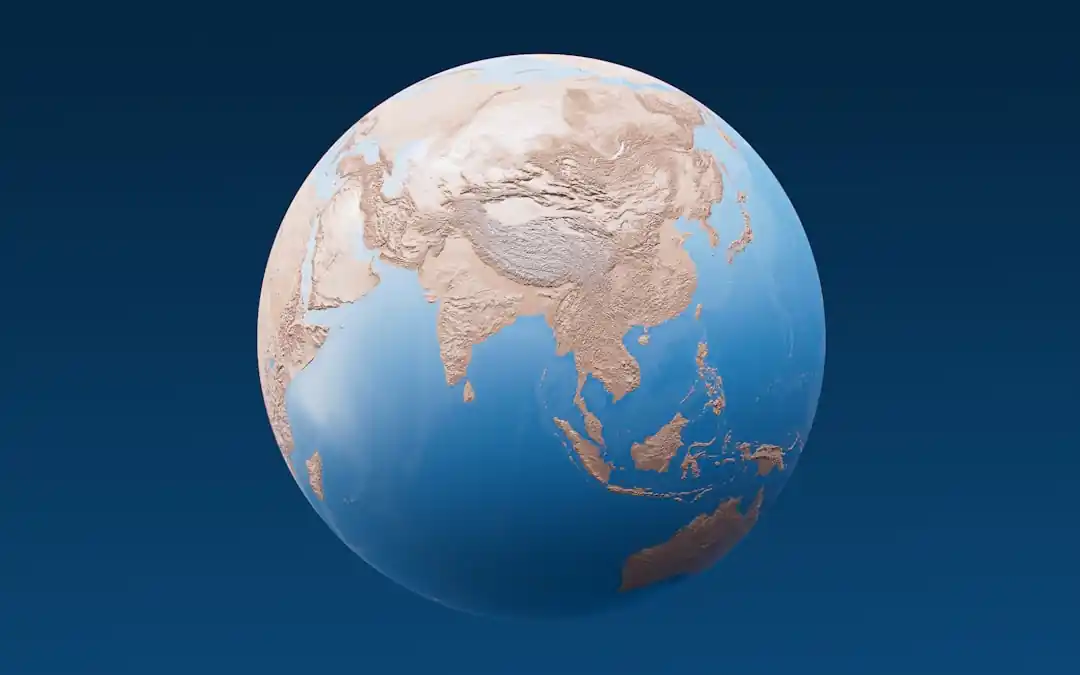
Google Earth Engine is a revolutionary platform that combines a multi-petabyte catalog of satellite imagery and geospatial data with planetary-scale analysis capabilities. Scientists, researchers, and developers use it to detect changes, map trends, and quantify differences on the Earth's surface. You can track deforestation in the Amazon, monitor the retreat of glaciers, or assess drought conditions, all within a web browser. Similarly, NASA's Earthdata Search and Worldview interfaces allow anyone to browse and download incredible, high-resolution satellite imagery, often updated daily.
For those who need to perform more complex spatial analysis, GIS (Geographic Information System) software is key. QGIS, a free and open-source option, and ArcGIS, a powerful commercial suite, are the industry standards. These tools are used to create maps, analyze spatial patterns, and manage huge datasets tied to specific geographic locations. While their primary use is for Earth, the same principles and software are used to map the surfaces of the Moon and Mars, creating detailed topographical maps from rover and orbiter data.
The New Frontier: AI and Autonomous Analysis
The next great leap in space data analysis is being driven by artificial intelligence. The sheer volume of data from next-generation telescopes, like the James Webb Space Telescope, is so immense that it's impossible for humans to sift through it all manually. AI and machine learning algorithms are becoming essential partners in discovery.
These intelligent systems can be trained to identify patterns that a human might miss. For example, AI can scan thousands of hours of observations to find the subtle dip in a star's light that indicates a passing exoplanet. NASA's ExoMiner is a neural network that does just this, and it has already validated hundreds of new planets. This frees up human astronomers to focus on the most promising candidates for further study.
Furthermore, AI is being built directly into spacecraft and rovers to enable autonomous decision-making. The communication delay between Earth and Mars can be up to 20 minutes each way, making real-time control impossible. An AI-powered rover can analyze its surroundings and decide for itself which rock is scientifically interesting enough to sample, or which path to take to avoid an obstacle. This capability is not just a convenience; it's what will make ambitious future missions to the outer solar system and beyond possible.
From the foundational code written by a graduate student to the AI making decisions on another planet, software is the invisible thread that connects us to the cosmos. It’s a quiet, digital revolution that is constantly unfolding, bringing the secrets of the universe out of the darkness and into the light. And the most exciting part? So much of it is open for you to explore, right from your own screen.

No Signal? No Problem: How Satellite Phones Actually Work
The Interstellar Internet: How NASA's DSN 'Talks' to Deep Space Probes
Related Posts
 MOBILE
The Great Console Debate: How to Choose the Right Gaming System for Your Family
Feeling stuck between a Switch, a PlayStation, and an Xbox? Let's break down which gaming console is the perfect fit for your family's game nights.
 MOBILE
From Fragile to Formidable: The Surprising Evolution of Foldable Phone Durability
Remember when the idea of folding a smartphone screen in half felt like a disaster waiting to happen? Let's talk about how far they've come, because the story is pretty incredible.
Popular Posts

Rethinking Non-Profit Promotion: Creative Strategies That Actually Drive Event Impact

Beyond Stark White: The Best Interior Paint Colors to Light Up Your New Space

How to Actually Master a New Language on Your Own (No Magic Gene Required)
