It’s a dream many of us share—trading daily commutes for dolphin escorts. But what kind of boat can truly take you to the world's most remote and beautiful corners?
There’s a certain kind of quiet that only exists miles from shore, a profound stillness where the only sounds are the wind in the sails and the gentle lapping of water against the hull. It’s a quiet that many of us, caught in the relentless hum of modern life, dream of. This dream often has a setting: a remote, sun-drenched archipelago, a string of emerald islands set in a turquoise sea, accessible only to the most determined explorers. For those of us who feel this pull, the liveaboard life isn't just a fantasy; it's the answer.
But turning this dream into a reality begins with a monumental question: what kind of boat can actually do this? I’m not talking about a weekend jaunt to a crowded bay. I mean a vessel capable of being your home, your transport, and your sanctuary for weeks or months on end, far from civilization. Honestly, the more I research, the more I realize that choosing a boat for remote exploration is less like buying a vehicle and more like choosing a partner for the adventure of a lifetime. It needs to be resilient, self-sufficient, and above all, safe.
This isn't about finding the fastest or flashiest boat in the marina. It's about finding a floating sanctuary, a vessel with the integrity to handle unpredictable weather, the storage to carry you between distant ports, and the comfort to make life on the ocean a joy, not just an endurance test. It’s a decision that will shape every aspect of your journey.
The Great Debate: Monohull vs. Catamaran
Before you even get into specific brands or models, the first major decision is often choosing between a monohull and a catamaran. This choice fundamentally shapes your life at sea. Monohulls, the classic single-hulled sailboats, are celebrated for their seaworthiness and their ability to handle heavy weather. Their weighted keels give them incredible stability and the all-important self-righting capability, which is a huge psychological comfort when you're a thousand miles from land. They offer a feeling of being "in" the water, slicing through waves with a satisfying heel. For many purists, this is what sailing is all about.
On the other side of the debate are catamarans. With their two hulls, they offer a level of stability and living space that monohulls simply can't match. They sail flat, which means more comfort underway and less fatigue for the crew. At anchor, they are exceptionally stable, avoiding the rolling motion that can make nights in a swell uncomfortable on a monohull. This stability, combined with a huge amount of deck and interior space, makes them feel less like a boat and more like a floating apartment.
For exploring remote archipelagos, the catamaran has a secret weapon: a shallow draft. Because they don't have a deep, heavy keel, catamarans can often sneak into anchorages and coves that are inaccessible to most monohulls. This opens up a whole new world of exploration, allowing you to anchor in calm, protected waters right off a deserted beach. While they come at a higher price point, the space, comfort, and shallow-water access are powerful arguments for those prioritizing exploration and livability.
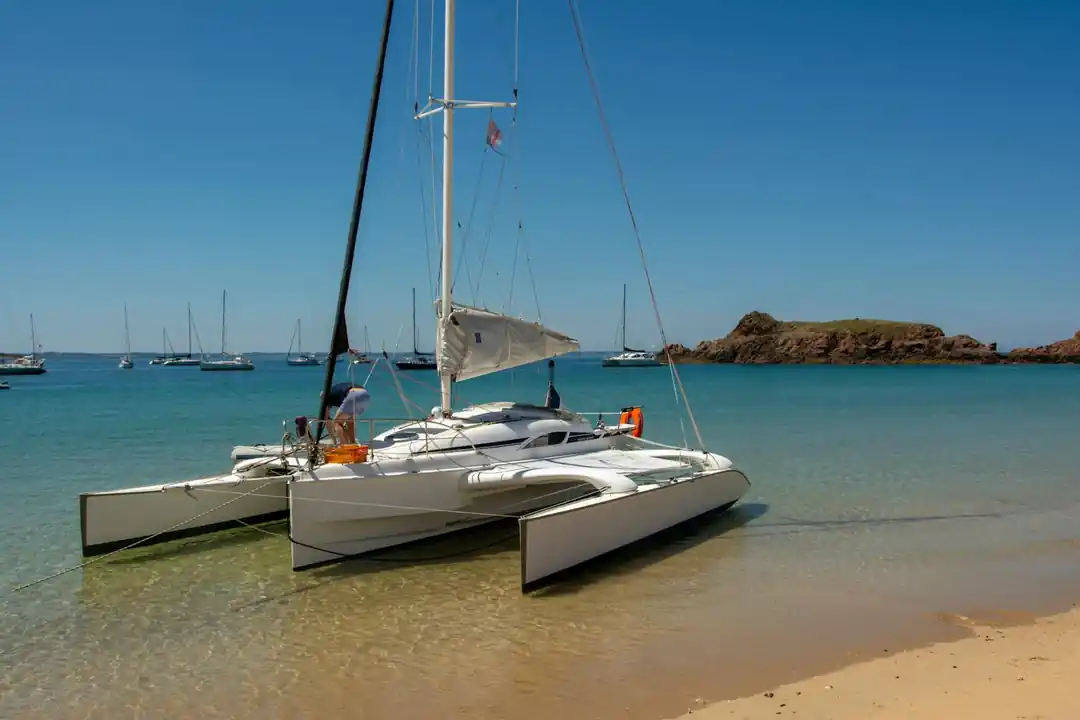
Built for the Blue: Key Features of an Expedition Boat
Whether you lean towards one hull or two, a true expedition-ready liveaboard shares a common DNA. These are not your average coastal cruisers. They are purpose-built with an obsessive focus on durability and self-sufficiency. The construction needs to be robust, with a solid hull and reinforced deck fittings. You'll hear seasoned sailors talk about "bluewater" boats, a term that signifies a vessel designed and built to withstand the rigors of open-ocean passages. Brands like Hallberg-Rassy, Amel, and Island Packet for monohulls, or Leopard, Fountaine Pajot, and Lagoon for catamarans, have built their reputations on this kind of reliability.
Self-sufficiency is the next critical piece of the puzzle. When the nearest grocery store is an ocean away, your boat needs to be a self-contained ecosystem. This means generous tankage for water and fuel, far beyond what you'd find on a standard cruiser. It means having robust systems for generating power, like a bank of solar panels, a wind generator, or both, to keep your navigation equipment, refrigerator, and lights running without needing to run an engine every day. A watermaker, which turns seawater into fresh drinking water, is often considered an essential piece of kit for true remote cruising.
Finally, there's the simple, unglamorous but absolutely vital factor of storage. You need space for months' worth of food, an extensive toolkit, and a wide array of spare parts for every critical system on board. A well-found liveaboard has a place for everything, from engine filters to sail repair kits. This level of preparation is what separates a hopeful dream from a successful voyage. It’s the confidence of knowing that when something inevitably breaks, you have the tools and the parts to fix it yourself, right there in the middle of paradise.
Don't Forget the Engine Room (Even on a Sailboat)
While the romance of sailing is powered by the wind, the practical reality of cruising involves a reliable engine. In remote archipelagos, you'll encounter calm days with no wind, and you'll need to navigate tricky channels or escape approaching weather. A dependable, well-maintained diesel engine isn't a backup; it's an essential tool. For long-distance cruisers, accessibility for maintenance is key. You should be able to easily check the oil, change filters, and inspect belts.
For those considering a powerboat, the options are just as compelling. Long-range trawlers, like those made by Nordhavn, are legendary for their ability to cross oceans in comfort and safety. They are the marine equivalent of a go-anywhere expedition vehicle. These boats prioritize fuel efficiency and incredible range over speed, carrying massive amounts of fuel to enable globe-trotting adventures. They offer enormous living space and a level of comfort that is hard to beat, making them a fantastic choice for those who want to explore in ultimate stability.
No matter the vessel, the principle remains the same: you need a boat that is simple, robust, and reliable. Complex systems are just more things to break when you're far from help. The best liveaboard boats are often the ones that blend modern comforts with time-tested, bulletproof design.
Choosing your vessel is the first chapter in an incredible story. It’s a journey of research, of learning, and of discovering what truly matters to you. Take your time, do your homework, and get on as many different boats as you can. When you finally step aboard the one that feels right—the one that feels like home—you’ll know. And the world’s most beautiful and remote places will be waiting for you.

Cash, Cards, and Paradise: A US Traveler’s Guide to Money in Mauritius
The Remote Island Dream: How to Find Paradise on a Shoestring Budget
Related Posts
 TRANSPORT
Beyond the Highway: Finding Canada's Soul on a Western Rail Adventure
Forget road trips. I'm talking about rediscovering the romance of travel on Via Rail's most scenic routes through the heart of the Canadian West. It’s an experience that changes you.
 TRAVEL TIPS
The Unwritten Rules of the North: What to Know Before Camping in Canada
Heading to the Great White North for a camping trip? It's an amazing idea. But from campfire etiquette to wildlife wisdom, here’s what you need to know before you go.

Popular Posts

Rethinking Non-Profit Promotion: Creative Strategies That Actually Drive Event Impact

Beyond Stark White: The Best Interior Paint Colors to Light Up Your New Space

How to Actually Master a New Language on Your Own (No Magic Gene Required)
